
How to Follow Up With a Client Without Being Pushy: The Complete Guide
 Ashley Frank · November 22, 2026 · 24 min read
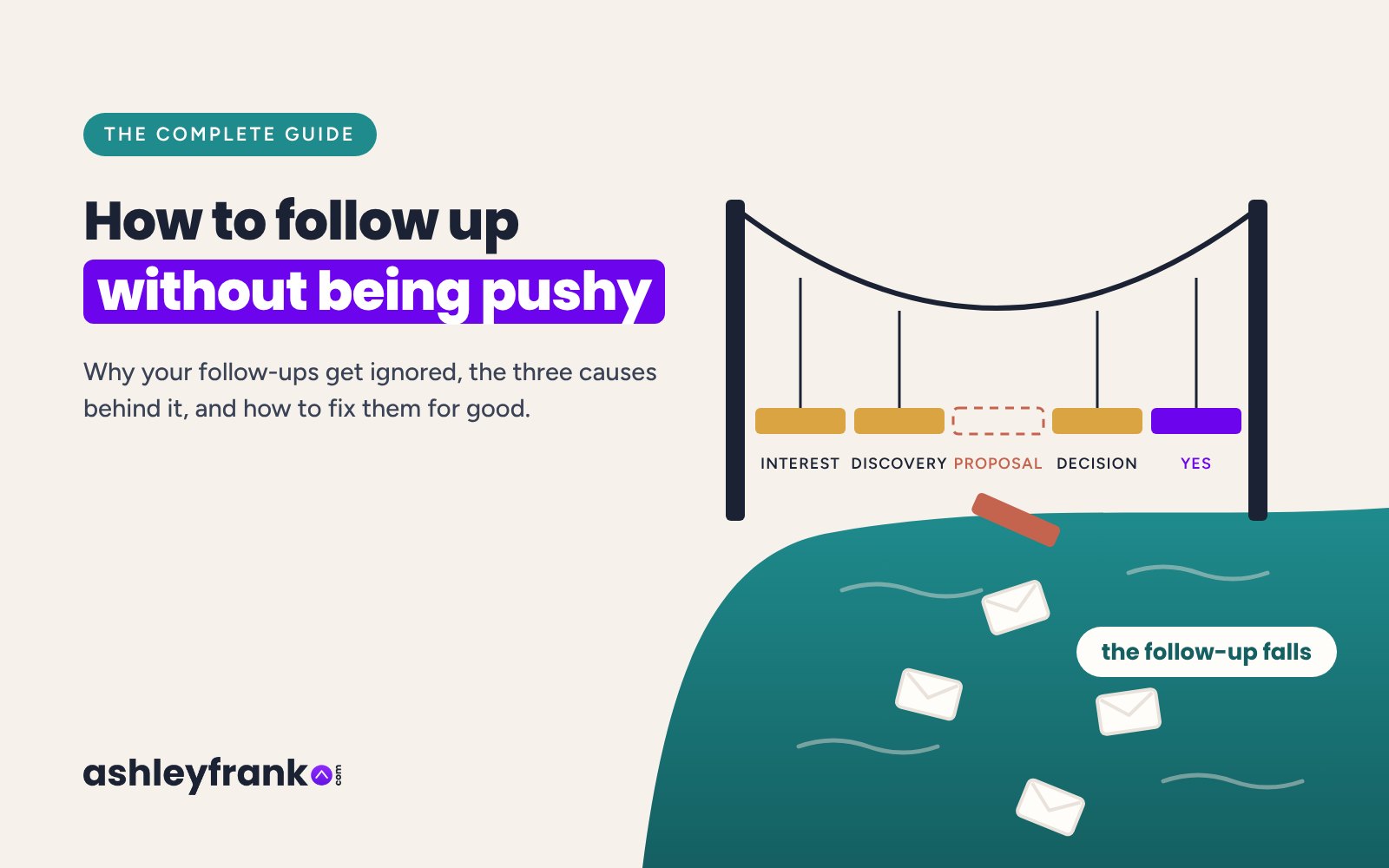
Follow-up: dreaded by most, done well by few, and a necessary part of growing a successful business.
The short answer: You follow up without being pushy by giving every follow-up a clear next step the client already agreed to. But that next step only works if a few things are in place first. Before you add a person to your follow-up list, make sure they’re actually qualified to work with you. Bring up the questions they haven’t asked, the hidden objections, even when they say they have no questions. Then establish the next step together, ideally in the calendar. Follow these steps, and your follow-up stops sounding like “just checking in” and starts sounding like “here’s what we said we’d do.”
Follow-up isn’t the problem. The real problem is not having a clear understanding of what you’re following up on and what outcome you expect, and not having everyone involved on the same page when it comes to expectations.
At first, a few follow-ups don’t seem like a big deal. But as the follow-up list grows, and more people leave your messages unanswered, things can get out of control quite quickly. This guide walks through why your follow-ups are getting ignored and how to fix them for good.
In this guide
- Follow-up is a system problem
- Your business is a series of systems
- Your growth comes from marketing and sales working together
- The job of your growth system
- Where marketing hands off to sales
- Where things typically break down: the follow-up falls
- The three core causes of endless follow-up
- How the three causes compound
- How to fix each cause
- What to do with your current follow-up list
- How to stop your follow-up list from growing
- Follow-up message examples
- Frequently asked questions
Follow-up is a system problem
Does this sound familiar? The call went really well. They said, “This sounds great. Send me something and follow up next week.” You said, “Absolutely.”
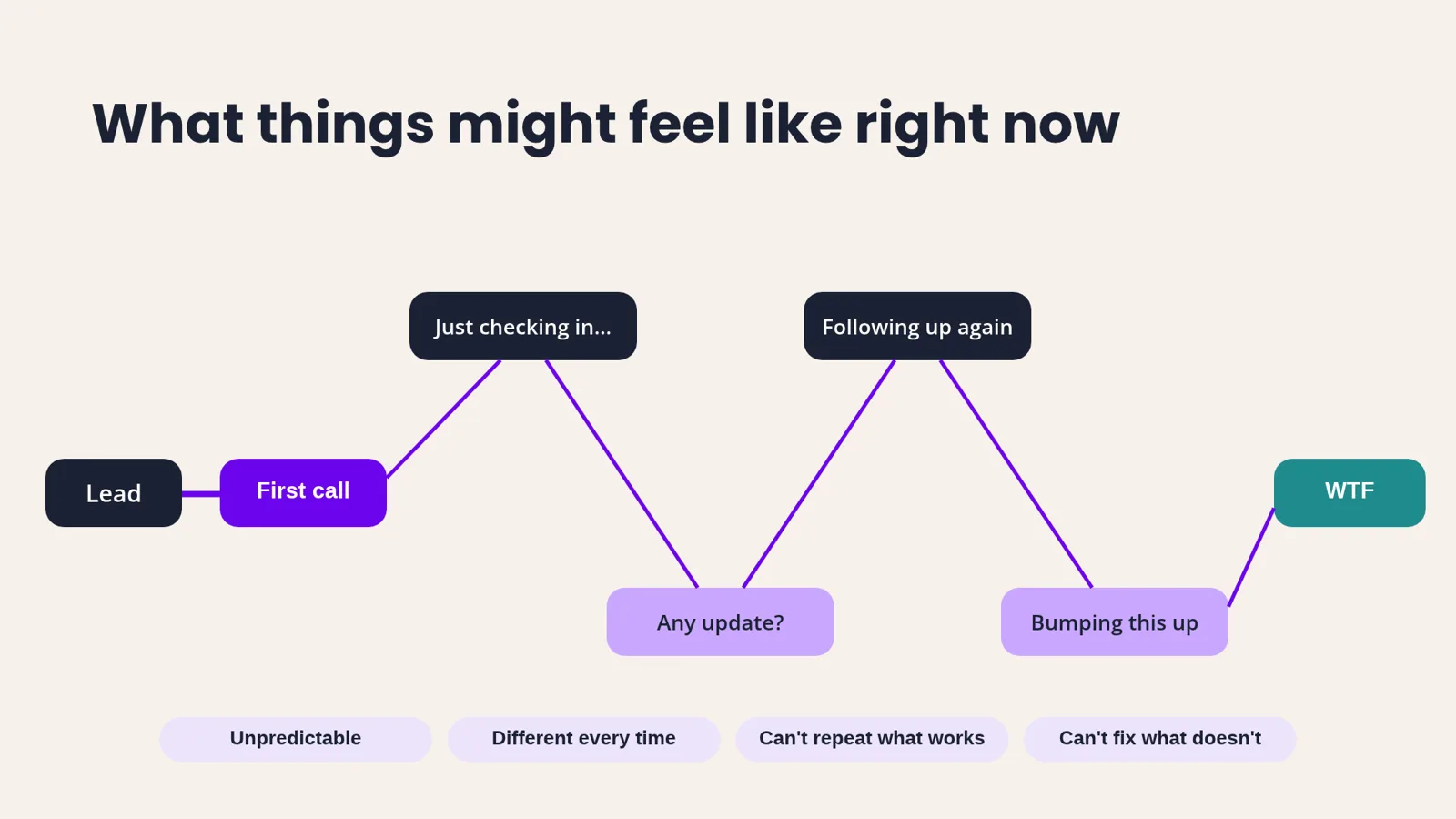
Three weeks later, you’ve sent “just checking in.” Then “just bumping this up.” Then, on a Friday afternoon, “circling back in case this got lost.” Nothing.
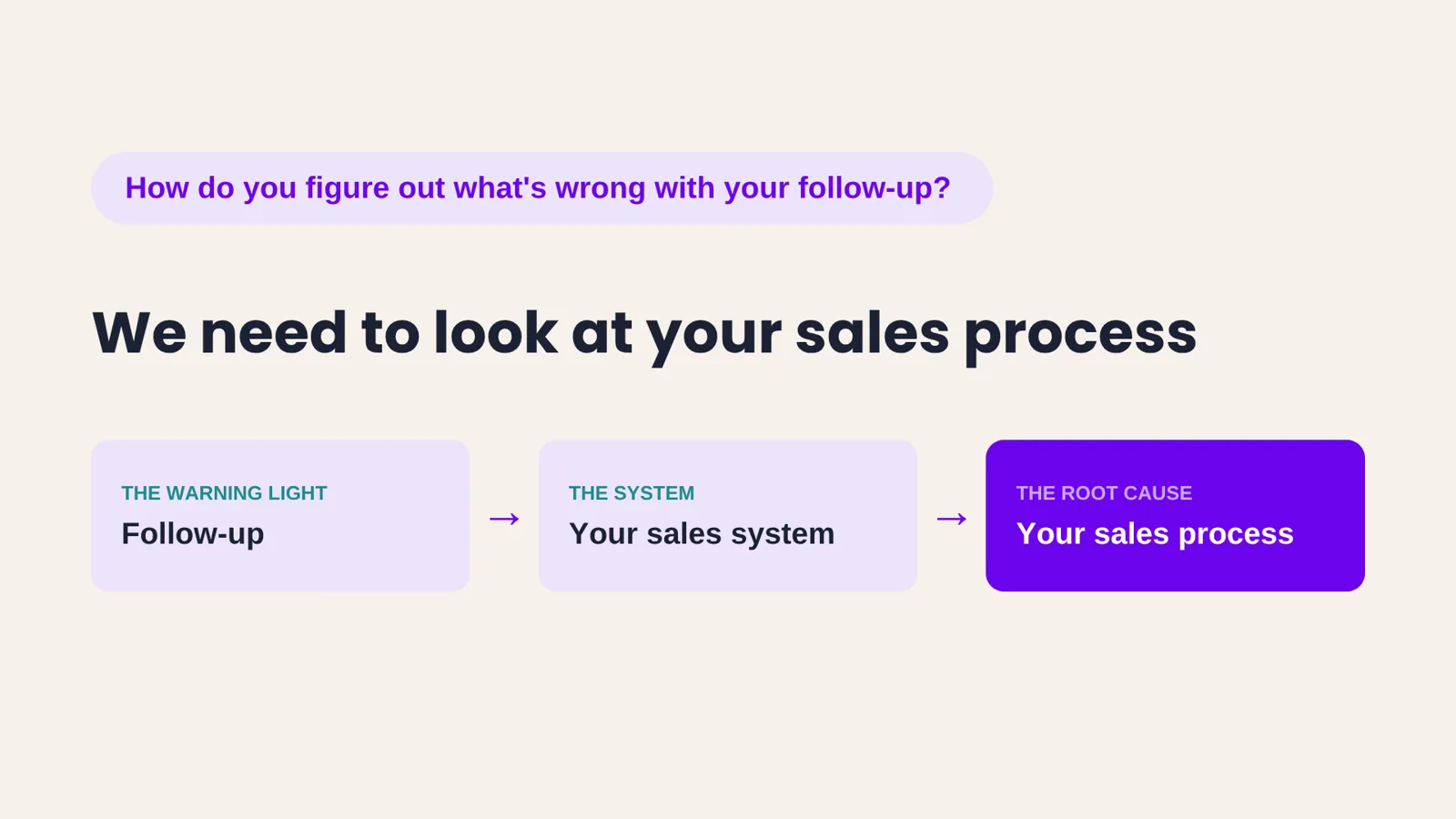
When that happens, it’s easy to take it personally, and the doubt creeps in. What did I do wrong? Did I not do a good job? Did I say something I shouldn’t have? But most of the time, being ignored isn’t about you. Something happened long before the follow-up ever started. You see, follow-up is a symptom of a bigger problem.
You might be asking, what do I mean by a symptom of a bigger problem? To get a clearer picture, think about your car. When a warning light comes on and you take it to your mechanic, a good mechanic doesn’t start pulling parts out at random. The warning light is just a symptom of something else going on, so they plug in the computer, find which system turned the light on, and then find the part inside that system that needs fixing.
A growing follow-up list is that warning light. And most of us start pulling things apart at random, trying to figure out what’s really going on. No shame, we’ve all done it. To fix our follow-up for good, we need to zoom out and find where things are breaking down.
Your business is a series of systems
To figure out where the follow-up breakdown is happening, we need to start seeing our businesses as a series of systems, not just a bunch of tasks.
When I talk with business owners, most of them don’t think in systems, and that’s understandable, because you’re often doing it all. Here’s what I often hear: “Today I made some posts, worked with a couple of clients, did some prospecting, and finally got my inbox to zero!”
But what that person really did was handle multiple roles inside their business, all in the same day: marketing, delivery, sales, operations, and admin. No wonder some days leave you feeling exhausted.
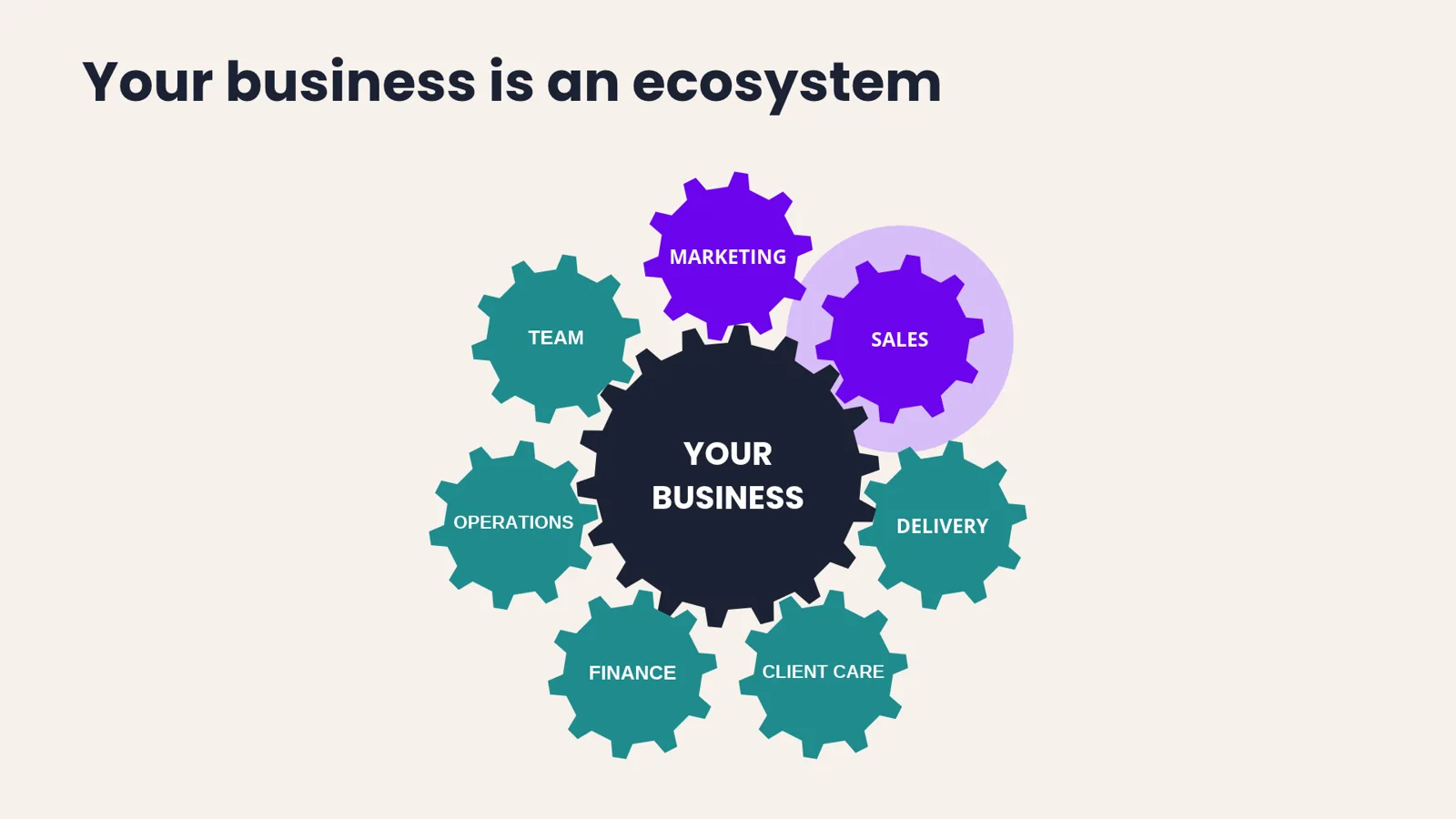
Every business is a collection of systems that together make an ecosystem: marketing, sales, delivery, operations, and finance. This is true whether you’re a team of one or a team of 100. In an effective business, each one is a system, and they all have to talk to each other.
If you just had an “aha” moment, congrats. If you just got a reminder, even better.
Thinking and working in systems is the first step to fixing your follow-up. With systems, you can diagnose where things are breaking down and fix them. With tasks, you often stay on repeat without ever getting to the heart of the problem.
Your growth comes from marketing and sales working together
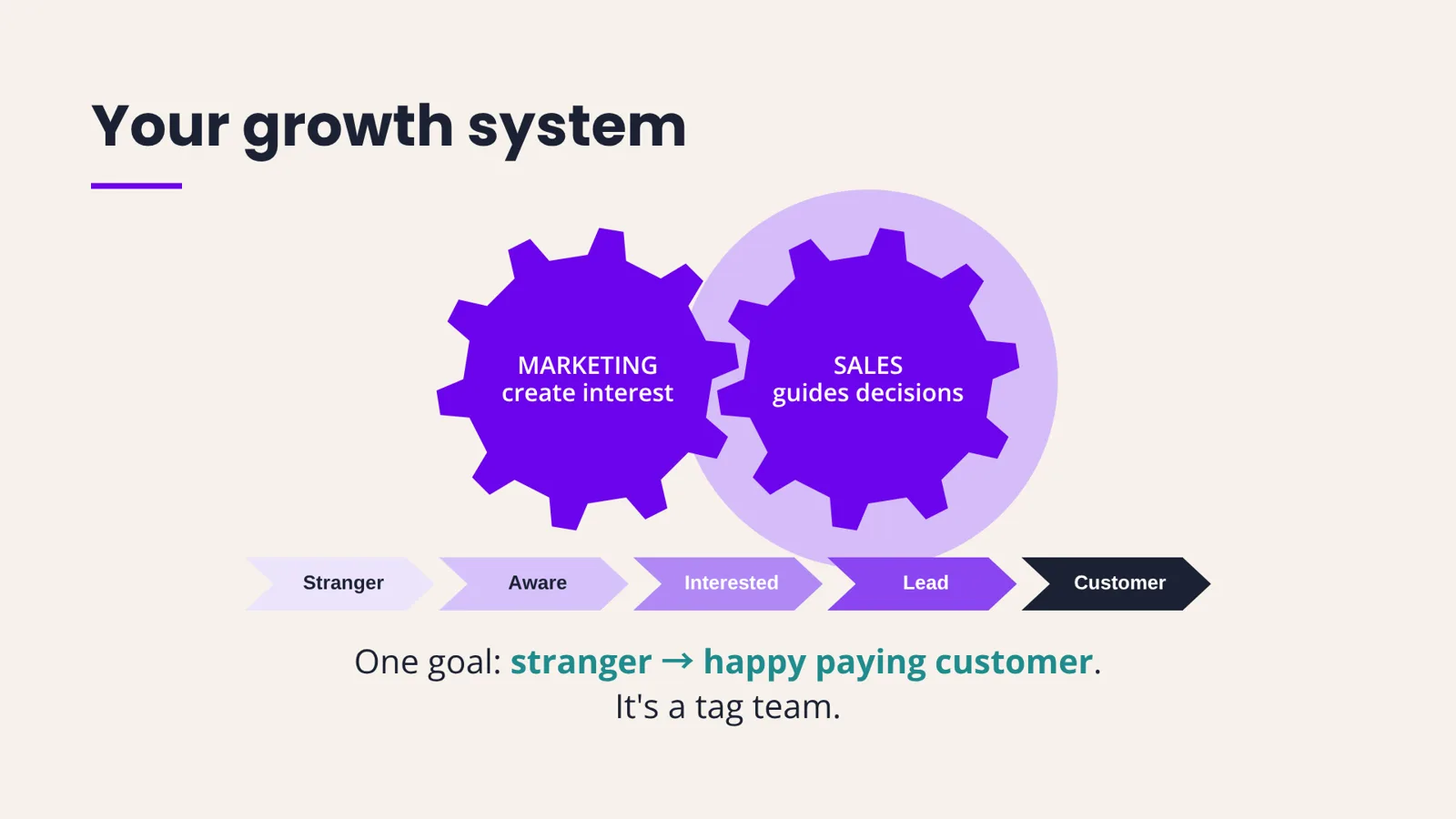
To fully understand the follow-up breakdown, it’s important to know which systems drive your growth: marketing and sales. Together, they make up your growth system.
Of all your business systems, these are the most important, because they bring in revenue, and revenue is what keeps the lights on. It’s what lets you pay yourself, hire a team and do all the things that make owning a business fun and worthwhile.
Many people, even established businesses, treat marketing and sales as separate jobs: today’s a marketing day, tomorrow’s a sales day. But the most successful businesses keep their marketing and sales tightly connected. They work as a tag team. When marketing and sales are disconnected, growth slows and becomes unpredictable, and your customers can feel the disconnect.
The job of your growth system
Your growth system (marketing and sales) has one job: take a stranger and guide them to becoming a happy, paying customer. That’s it. Sounds simple, right?
The best growth systems do four things really well:
- They bring the right people to you. People who can work with you and have a problem you can solve.
- They work without pressure. You should never have to convince someone to work with you. The best sales happen when you guide someone from interested to a decision without a hard close. Hard closes rarely work in the long term.
- They keep every opportunity moving. Whether your deals live in your head, on sticky notes, in a spreadsheet, in your inbox or in your CRM, a good growth system keeps each one moving toward a decision: yes or no.
- They make it easy to see what’s working and what isn’t. That’s how you know what to repeat and what to improve.
Where marketing hands off to sales
When a customer decides to work with you, their decision usually isn’t random. Every person follows a buyer’s journey when deciding to make a purchase, whether they’re buying from you, buying a new car or grabbing a bottle of ketchup at the grocery store. Your marketing and sales work together to guide a potential customer along that journey, toward working with you.
Marketing is typically the entry point for your growth system. It attracts strangers who fit your ideal client profile (ICP) through your website, social media, events, referrals, direct outreach and ads. It builds awareness and then interest. It’s important to note that interest comes in levels. There’s cold interest, like a new follower or a social like or comment, and warm interest, like an email reply, a website request, a download or someone asking you directly for more information.
So when does the handoff between marketing and sales happen? It depends. Every company has a different definition of a lead, and that definition often evolves as the business grows. (I’ll cover the levels of awareness and how they relate to lead quality in a future post.) For now, our definition of a lead is someone who raises their hand and expresses interest in learning more about what you offer. They reach out with their name, email and possibly a phone number, whether online, over the phone or in person. At this point, they’ve gone beyond a like or a comment and have explicitly asked for more information.
This is where the sales system starts to kick in. Sales guides an interested person from “I’d like to explore this” to “I’m ready to make a decision,” whether that decision is to work with you or not right now.
This doesn’t mean marketing stops. It just means sales now becomes the primary function until a decision is made.
Your follow-up lives inside the sales part of the buyer’s journey, and this is where the breakdown happens. Remember, follow-up is your warning light that something isn’t right. That leads us to the sales system, and eventually to the process inside of the system.
Where things typically break down: the follow-up falls
The sales process will be slightly different for every business, and it should always map to the buyer’s journey. For this guide, I’m going to use a typical sales process for a service-based business. With a few tweaks, it works for most businesses.
Here’s what it often looks like: a lead comes in (that handoff we just talked about), you have a discovery call, and you present a proposal or quote. You’re excited, so you send them everything. They ask for some time to review it. Then the follow-up starts: following up, following up again, “just checking in,” “just circling back.” The follow-up can seem endless.
It helps to think of your sales process as a bridge. Its number one job is to take someone who has raised their hand and guide them safely to the other side, from interested lead to happy buyer. Below the bridge is fast-moving water. I call it the follow-up falls. When your sales process isn’t clear or is missing important steps, people fall off the bridge and into the falls. Once someone falls in, it’s hard to get them back. The current is strong, and they often get swept downstream to a competitor or into the pond of indecision.
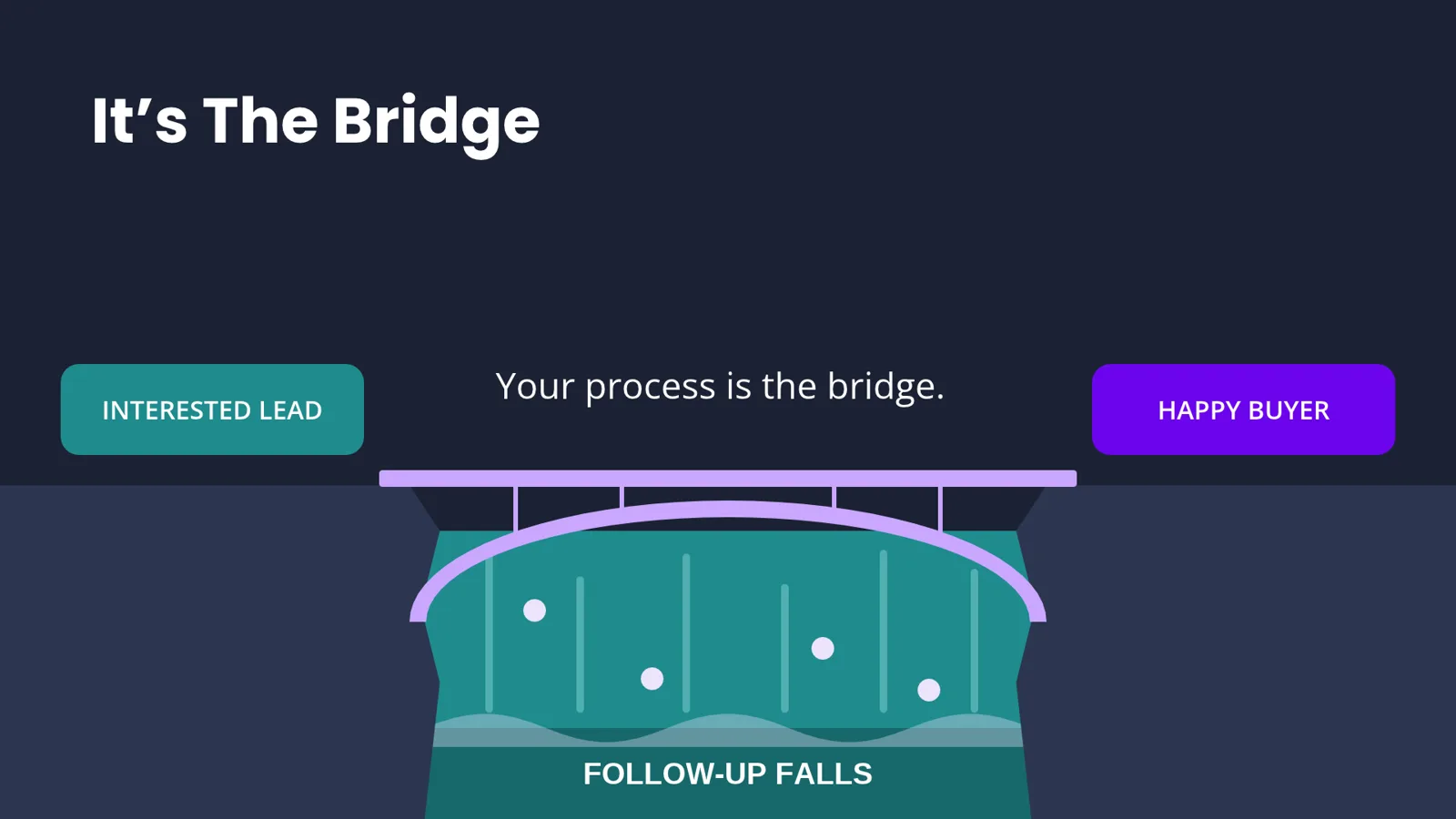
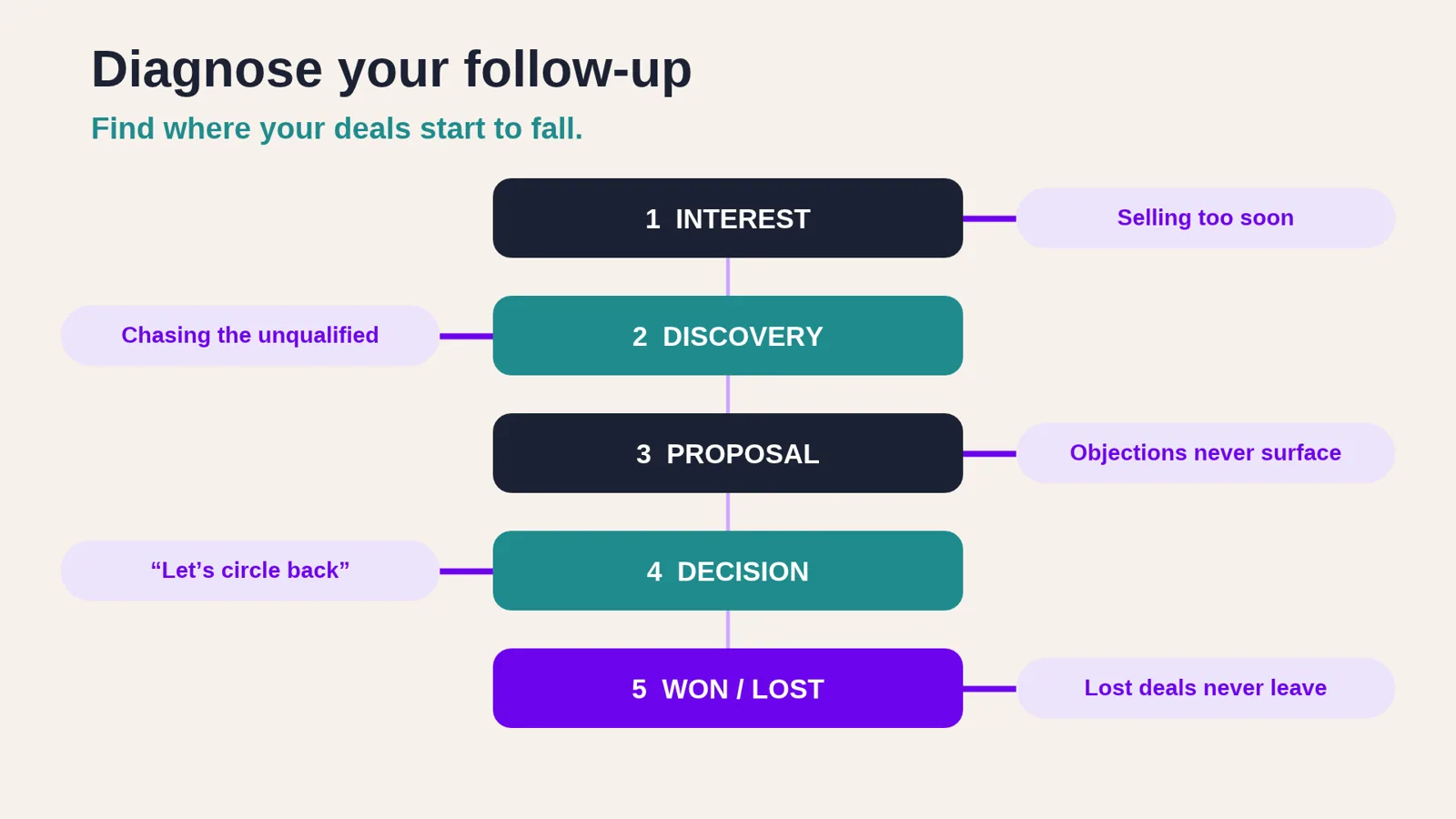
That typical process is a good starting point, but to see exactly where people slip into the follow-up falls, we need to put a bit more structure around it. You may already be doing some of this. To keep people on the bridge, though, you need a clear process you can repeat and master. In this guide, the stages are: interest, discovery, proposal, decision, and won or lost. People usually fall in at one of these points:
Interest (the handoff): selling too soon. A lead comes in, you get excited and say, “I’ll send over a proposal and follow up next week,” before you really know whether they want to do business with you.
Discovery: chasing people who were never a fit. Even warm referrals aren’t always qualified.
Proposal: sending a proposal while questions and concerns are still unspoken.
Decision: the “let’s circle back” loop, where nobody knows what’s being circled back on.
Won or lost: avoiding a clear yes or no, so the deal never leaves your list. A clear no is better than an endless maybe, because it frees up space for the next person who’s ready.
The three core causes of endless follow-up
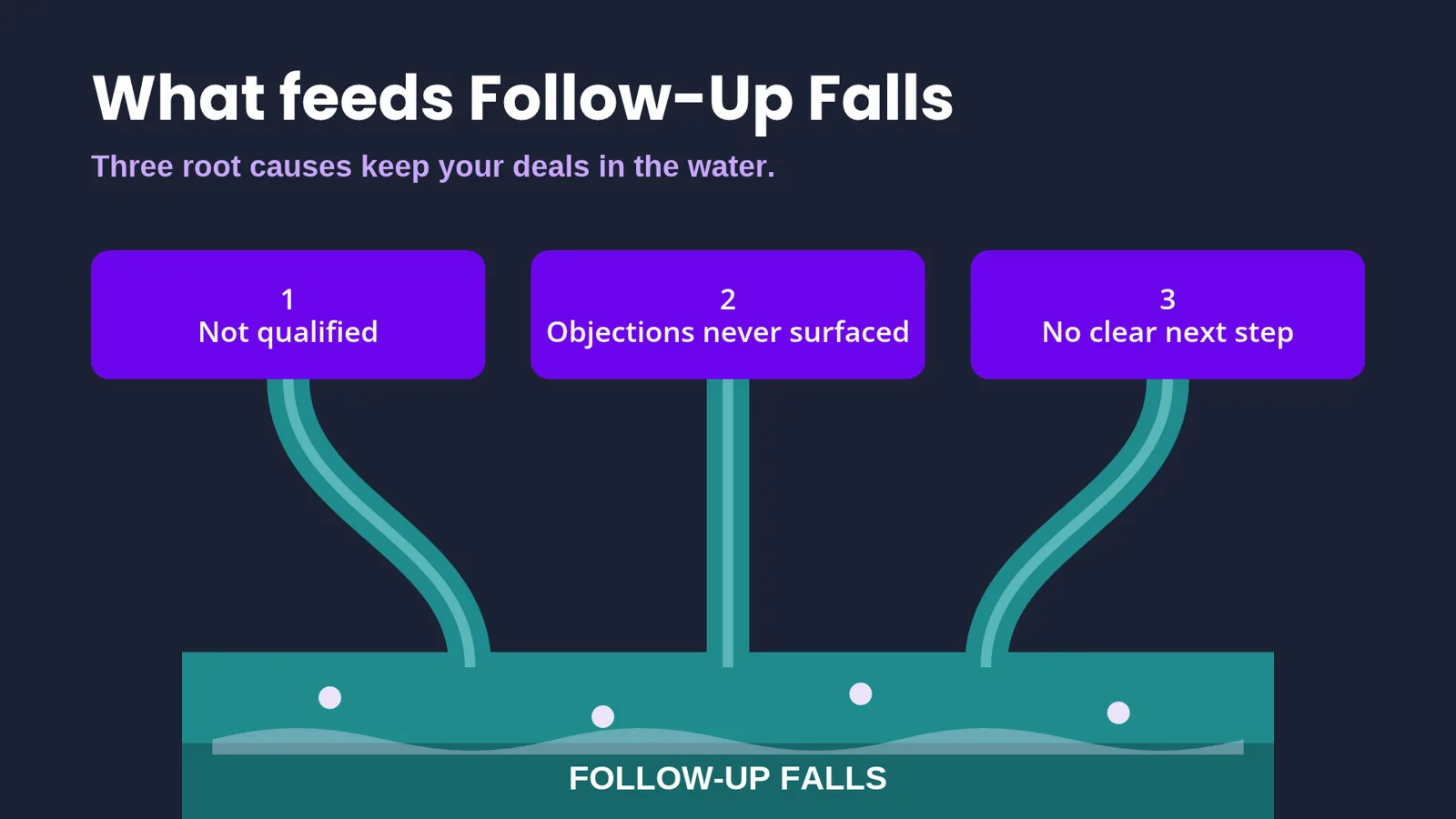
Earlier, I said follow-up is a symptom of a bigger problem. Now that you’ve seen how your systems work together and where the sales process fits, let’s get into the three core reasons people slip into the follow-up falls, and why the follow-up starts to feel endless.
Cause 1: They were never qualified to work with you
Yep, you might be following up with people who were never qualified to work with you in the first place. This is the leading cause of endless follow-up.
Not every lead is going to be qualified to do business with you. Most of us get excited when a new lead comes in. Someone’s interested, and we start down the path of “let’s close this deal.” But if you’re trying to sell to an unqualified lead, you’ll run into all kinds of challenges, and endless follow-up is one of them.
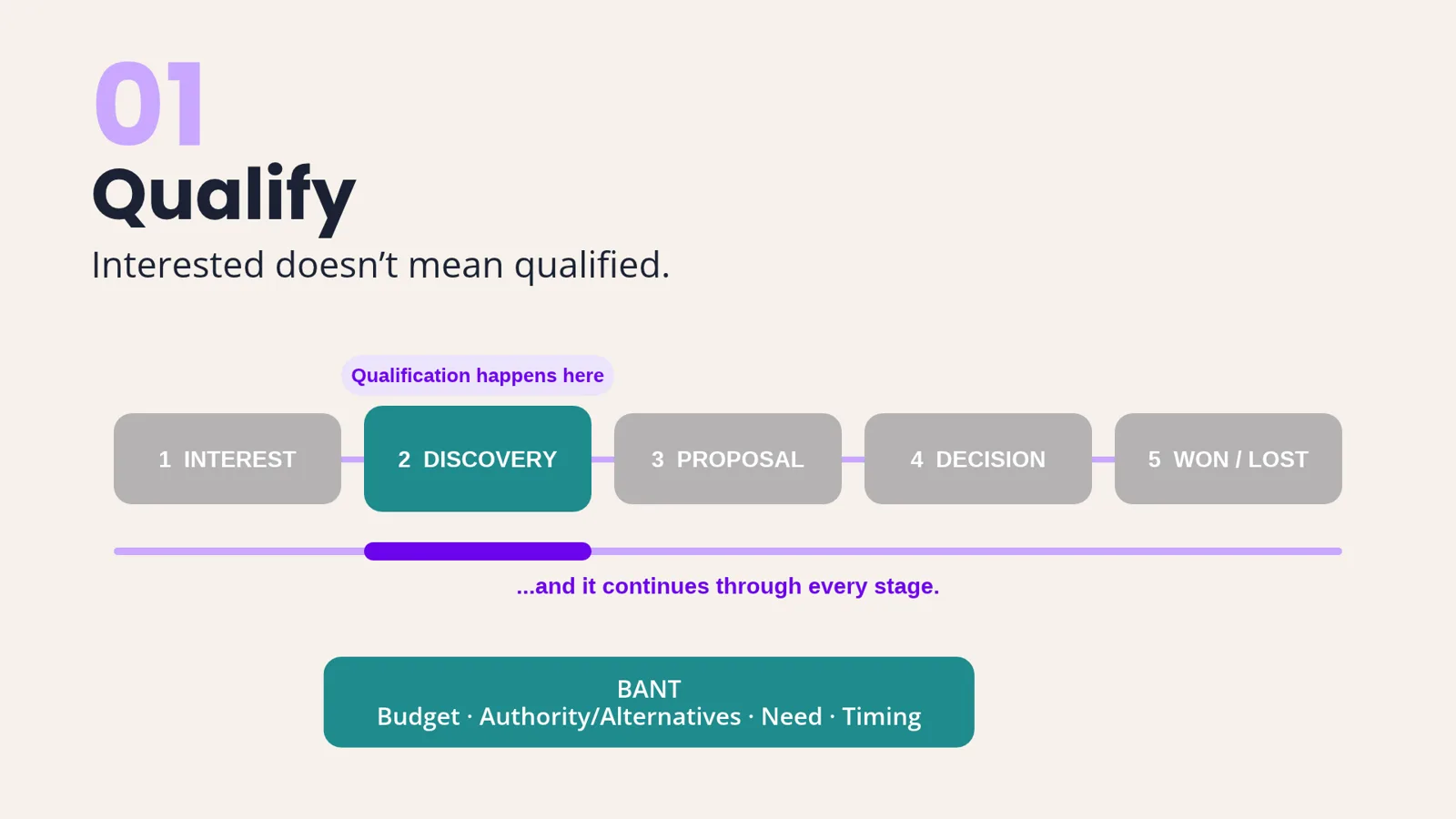
Throughout your sales process, you’re always confirming whether a lead is qualified, and things can change as you gather more information. Qualification centres on someone’s ability to work with you, based on Budget, Authority/Alternatives, Need and Timeline (BANT). If you never confirmed their budget, who makes the decision, what else they’re considering, what they need and when they need it, you may be following up with someone who was never going to buy, and who probably wouldn’t have been a great client anyway. I’ll show you how to qualify in Fix 1: Qualify with BANT, later in this guide.
Cause 2: Not uncovering questions and concerns
At the end of most meetings, you ask, “Any questions?” and they say, “No, it sounds great. Send me the proposal.” Then they disappear.
If they were qualified to work with you and then went silent after a conversation like this, it’s usually because they have questions, concerns, or doubts that weren’t addressed during the meeting.
Most people come to you for help. But even though they need your help, they often aren’t comfortable asking questions, or don’t know what to ask, because they’re inside the problem. There’s a saying I once heard: “You can’t read the label from inside the bottle.” Being inside a problem is much the same. People can’t ask about what they can’t see or don’t fully understand. And nobody wants to look “dumb,” so they avoid asking and default to the easy “everything looks good.”
It is your job to guide them through those unanswered questions and concerns. I’ll show you how in Fix 2: Bring up the questions they haven’t asked.
Cause 3: No clear next step (or one only you own)
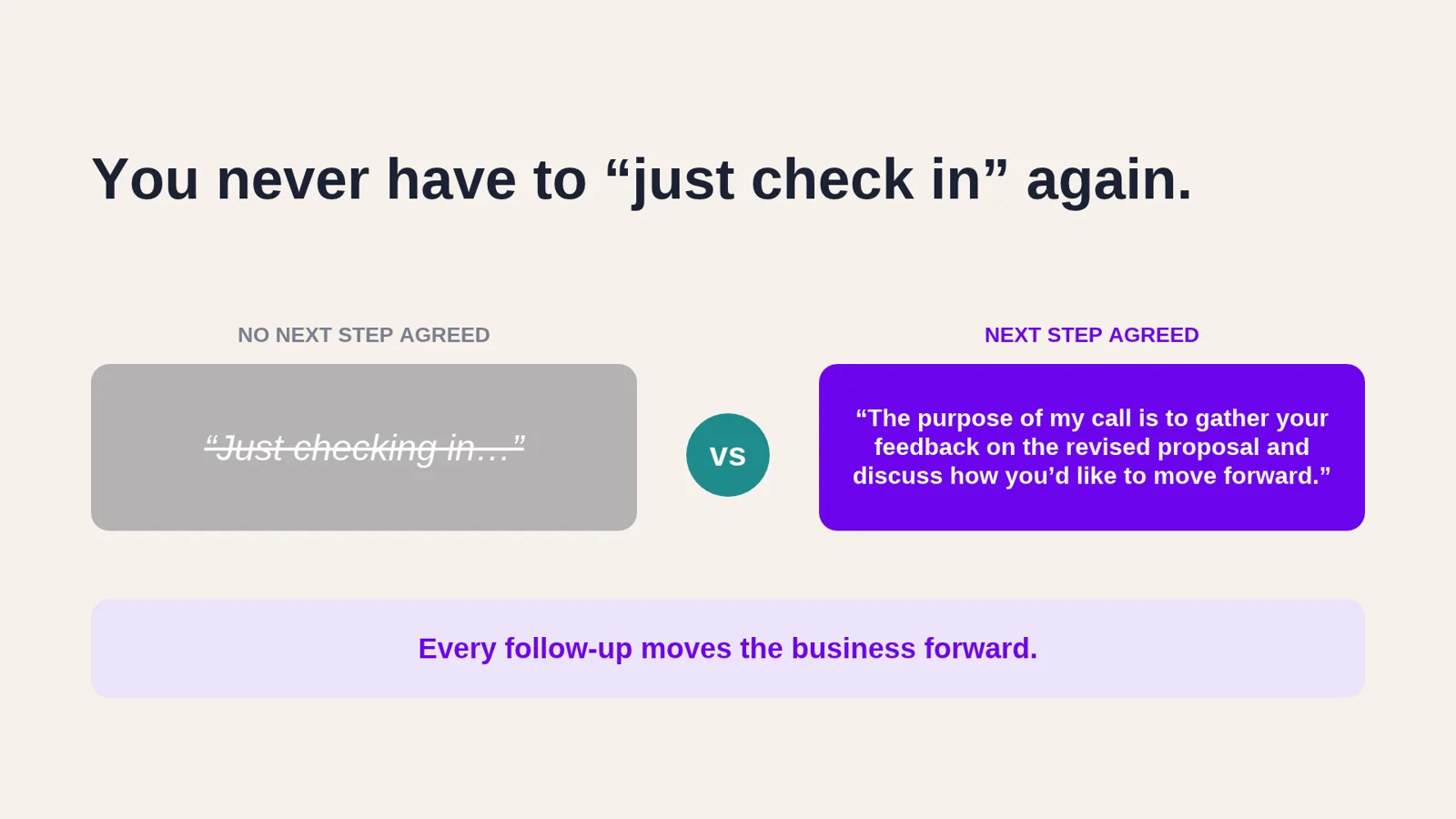
“Send it over and follow up with me next week” sounds like a next step. It isn’t. This next step is 100% owned by you, and you become 100% accountable for it, even for the things outside your control. The other person has no skin in the game, and that’s when follow-up starts to feel heavy, and you begin to wonder what you did wrong.
As I mentioned, the main goal of your sales process is to guide a potential buyer across the bridge to a decision. That’s a shared responsibility, because you can’t guide someone who isn’t willing to take the next step with you.
The fix is to always have a mutually agreed-upon next step, with clear expectations and, preferably, a time in the calendar. Just as important as the expectations is agreeing on what happens if someone doesn’t show up. More on this in Fix 3: Determine the next step together.
How the three causes compound
The causes of endless follow-up above don’t happen one at a time. They stack.
If someone isn’t qualified, you might be guiding them along a sales journey when they’ll never be able to afford your offer. Or worse, you might be selling to someone who can’t make the decision on their own, and the people who do need to be part of it magically appear halfway through or near the end. That’s always an unexpected and unwelcome surprise, and it often leaves you starting over.
With qualifying gaps like these still open, it’s hard to agree on a real next step, so you settle for “I’ll follow up next week.” Now you’re chasing a vague step that you fully own, with someone who may not be qualified, who has unanswered questions, and who may never do business with you because of it. Meanwhile, they can take up a lot of your valuable time.
It also chips away at your confidence. Each follow-up that goes unanswered makes the next one feel more awkward. You start to dread the list, so you avoid it, and it grows. And as long as that list is weighing on you, your time and energy aren’t free for the people who are ready to work with you.
The good news: there’s a fix for all three that you can start today. And if you fix the first one, qualification, the other two show up a lot less often.
How to fix each cause
Fix 1: Qualify with BANT
There’s an old saying in sales: ABC, always be closing. 🤮 I like to think ABC stands for always be confirming: confirming that the person you’re talking to is qualified to work with you at every stage of your sales process.
Qualification centres on four areas: budget, authority/alternatives, need, and timeline, or BANT for short. BANT has been around for my entire career, and I’ve seen it get a bad reputation. But used as a tool inside your sales process, it’s a game changer. It helps you work with people who are able to work with you, saving you time and a whole lot of follow-up frustration.
During every call, especially your very first one (discovery), make sure you uncover and clarify these four things (BANT):
- Budget: Do they have the ability to invest in what you’re offering, or have they made similar investments in the past?
- Authority (and Alternatives): Can they make the decision to move forward on their own, or do they need to involve someone else? What other options are they considering, or have they tried in the past?
- Need: What problem are they solving, and can you solve it? How well do they understand their own problem? You’ll be surprised how often buyers don’t have full clarity on what they’re trying to solve. This is your opportunity to shine like the top of the Empire State Building. (Sorry, my inner musical theatre personality is slipping through.)
- Timeline: When would they like the purchase completed, and what’s connected to that timeline? Another way to measure timeline is urgency. You could ask, “Where are you in your decision-making process?” or “How soon would you like to fix this problem?”
Of the four, I believe need is the most important, because if there’s no problem to solve, you have nothing to sell. Once you know you can solve their need, authority and alternatives come next, followed by timeline and budget.
If you leave a meeting unsure about any of these, go back to your ABCs (always be confirming) and uncover the missing details.
If you have existing follow-ups with people who aren’t fully qualified yet, that gap becomes the reason for your next follow-up. You could try something like:
“While reviewing my notes from our last call, I noticed I still had a few unanswered questions. Would you be open to a quick call so I can better understand where things stand?”
Fix 2: Bring up the questions they haven’t asked
People who come to you with a problem don’t know what they don’t know. They’re working from what they’ve pieced together on their own: online, from friends and colleagues, and even from your competitors. You’re the guide, so it’s your job to make it easy and create an environment where every question is valid.
When they say, “No questions,” try something like:
“At this point, a lot of people I work with are wondering two things: is now the right time, and is this the right fit for me? Is either of those on your mind?”
And if they say it’s all good:
“Great. Before we move to the next step, is there anything you think would stop us from getting to a decision?”
Then hold the silence. If you sense hesitation, gently explore a little further. It will feel uncomfortable the first few times. That’s normal. It’s also what will set you apart from everyone who’s just pushing a product. You’re not prying. You’re helping the buyer think beyond their surface-level understanding.
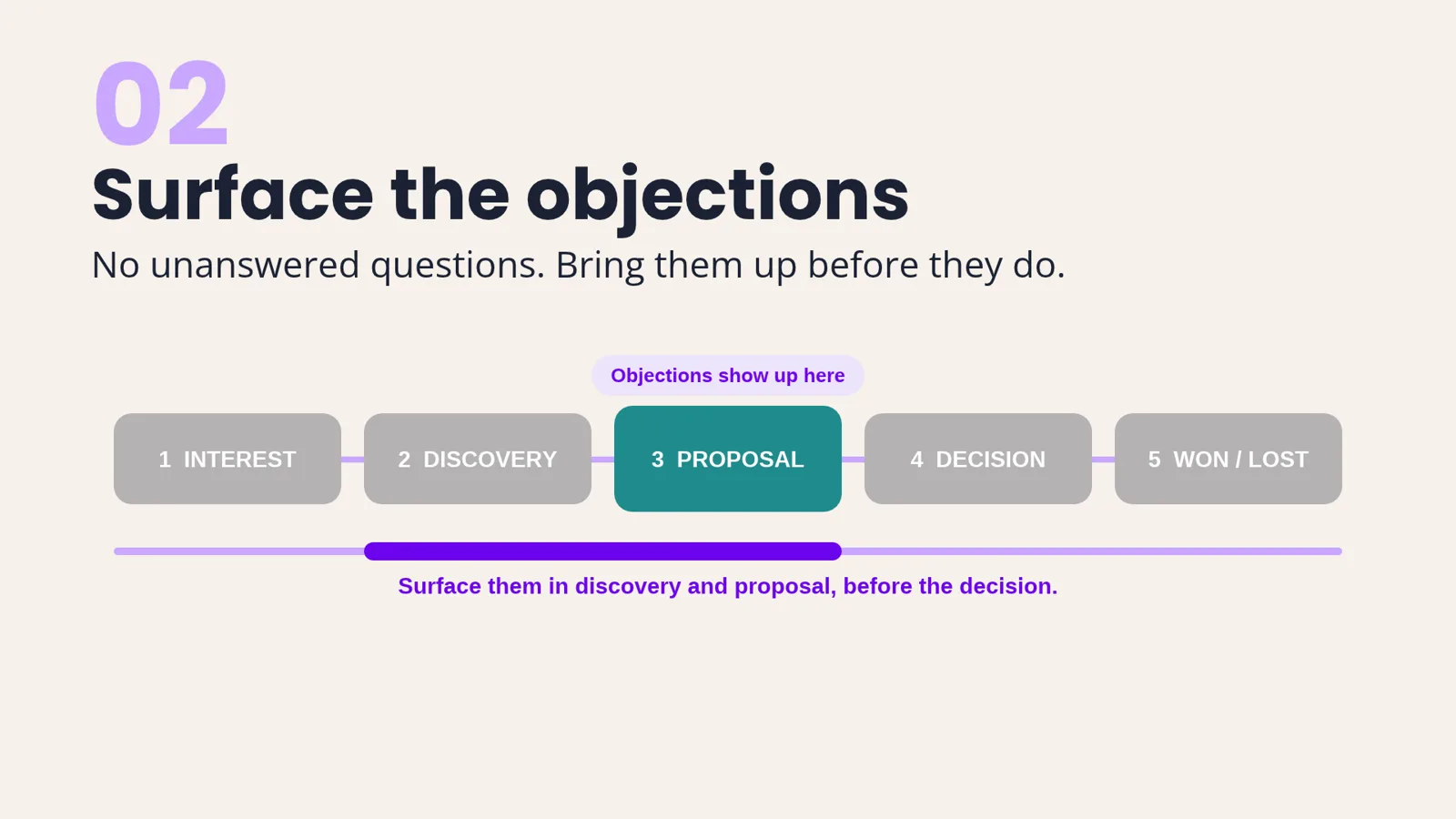
One way I do this in my own business: I don’t just email proposals. For every opportunity, I schedule a working proposal meeting, where I walk through the proposal with the client on a call. That way any questions come up while we’re together. Then I make any final revisions and send the proposal after the meeting.
It’s a game changer. When someone gets a proposal by email, they typically read it back to front: they flip to the pricing and make a preliminary decision. And if your buyer needs to share it with other stakeholders you don’t have access to, sending a proposal without discussing it first can lead to overwhelm, disconnect and, often, lost opportunities.
Fix 3: Determine the next step together
If you’re holding the entire next step yourself, you’re going to feel overwhelmed and dread the follow-up. Remember, the buying journey is a partnership, and the next step is a shared responsibility. Every touch point should end with a next step everyone has agreed to, preferably in the calendar before you hang up.
Here’s a line I use to get people into my calendar:
“If it’s not in my calendar, I’ll forget. Do mornings or afternoons work better for you? How about next Tuesday at 10?”
Once you have a mutually agreed-upon next step, ask one final question:
“If something comes up and we miss each other, what would you like me to do?”
Let them tell you what they’d like you to do if the next step is missed. This does two things:
- It gives you permission to follow up, in the way they’ve asked for.
- It helps you spot anything that might be in the way and needs to be worked through before the next step.
Sometimes the best next step is agreeing that there isn’t a strong opportunity to move forward. That saves you time and frees you up for the next opportunity, with someone who’s a better fit to work with you.
The best part: the mutual next step you set becomes the purpose of your next conversation. “The purpose of today’s call is to review the revised proposal, like we planned.” No “just checking in” required.
What to do with your current follow-up list
Now that you understand the root cause of your follow-up challenge, what the heck do you do with the ever-growing follow-up list? Don’t worry, I’ve got you.
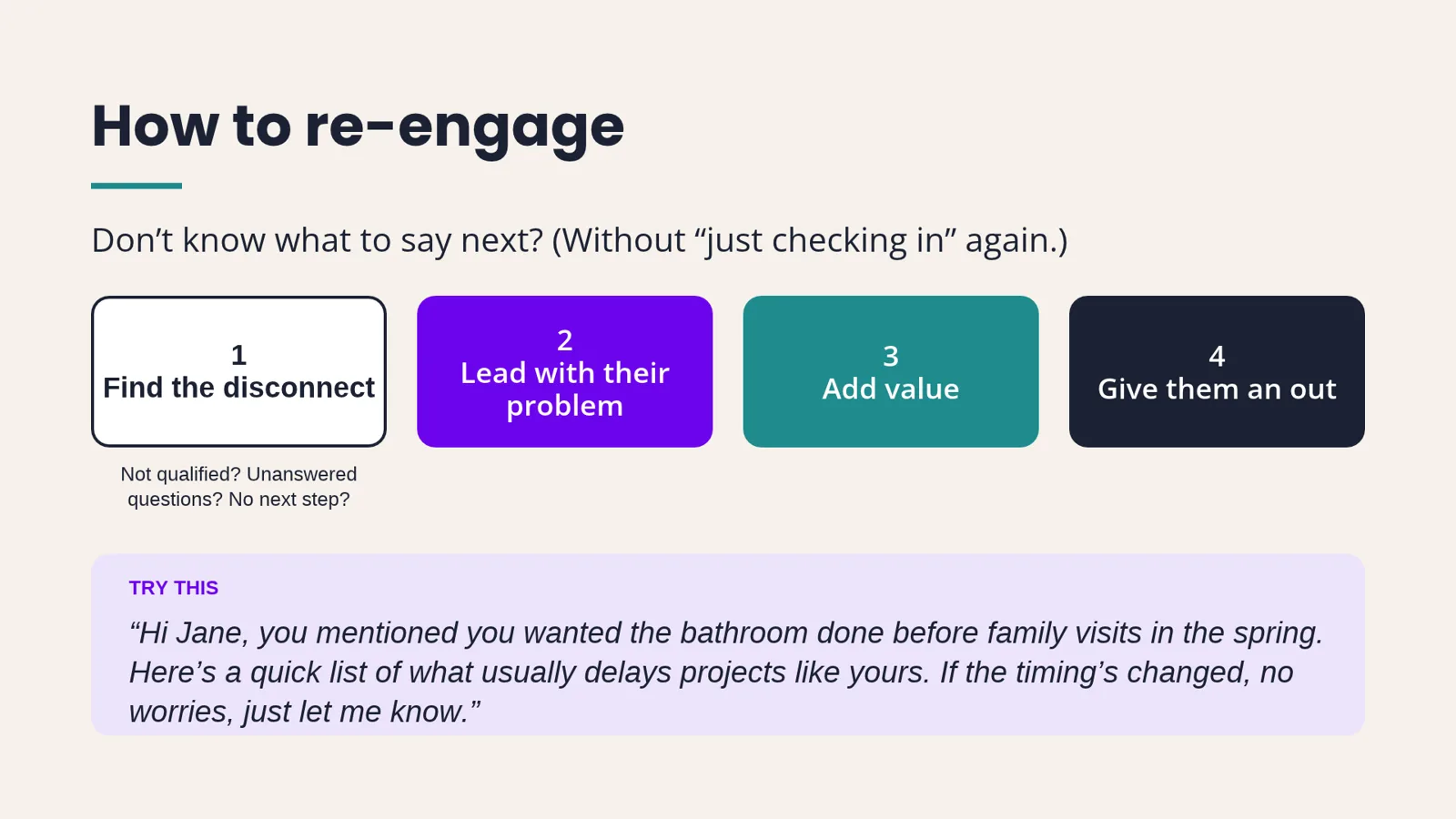
For each person on your follow-up list, you’ll either shape them up (re-engage and re-qualify them) or ship them out (release them because they’re not responding or aren’t a fit).
Start by finding the disconnect
Go through each name and ask:
- Did I miss part of qualifying them? Do I know their budget, decision-maker, need and timeline?
- Were there questions that never got answered?
- Was there a clear, agreed-upon next step?
Whatever you find becomes the reason for your next message. If you never confirmed their timing, ask about timing. People are okay with you going back. Just frame it as, “I was reviewing my notes and realized…”
Pro tip: always review your list in this order. If someone isn’t qualified, setting a next step won’t help you move them to a decision.
Re-engage with a reason
“Just following up” or “just circling back” isn’t a good reason to re-engage, and most of the time those messages get ignored. Here are four ways to supercharge your re-engagement with purpose:
- Lead with what matters to them. Remind them of the goal or deadline they shared, not your quote. This is the WIIFM: “what’s in it for me,” where “me” is the person you’re talking to. Always be thinking WIIFM in any kind of outreach.
- Add value. Instead of just following up, bring something useful: an article that’s relevant to their situation, or a case study from a client with a similar challenge. Anything that helps you stand out. Early in my sales career, I watched a rep send a cold lead a cheese pizza with a note inside the box asking them to call. Guess what? It worked.
- Give them an out. Breaking up is hard to do, even for potential customers. Some people don’t know how to say no, especially once you’ve built a relationship. So make it easy for them. Try something like: “I sense some hesitation that this might not be the right fit for you. If that’s the case, just let me know. No hard feelings.” You might be surprised how often that one message restarts the conversation, so you can either address their concerns or move them off your follow-up list.
- Close the file kindly. If you’re only getting silence and read receipts after several follow-up attempts, it’s time to step into your leadership power. Let them know you’re closing their file for now, leave the door open, and move them to an occasional nurture email or a “reconnect in three months” reminder. Often, this gets a reply: either they re-engage, or they send a kind “thank you” that keeps the relationship warm for the future.
If you have a long follow-up list, don’t try to do it all at once. Start with five names and work your way through a handful of names at a time until everyone is re-engaged or you’ve closed their file.
How to stop your follow-up list from growing
You now have the tools to handle your existing follow-up list. But wouldn’t it be great if you could stop new people from landing on it in the first place? Guess what… you can.
After every conversation with a potential client, run through this three-question checklist:
- Are they still qualified? Has anything changed with their budget, decision-maker, alternatives, need, or timeline? If so, what changed, and is this still an opportunity you want to pursue?
- Are there questions they haven’t asked? If so, it’s your job to bring them up proactively.
- Is there a clear next step everyone has agreed to? Make sure the outcome of that next step is clear, get it in the calendar if you can, and agree on what happens if someone doesn’t show up.
How to follow up without being pushy: 4 golden rules
In my experience, most people’s follow-up is pretty haphazard. It’s not intentional. They’ve just never been taught the four golden rules of follow-up. Follow these rules and you’ll stand out, no matter how you reach out: phone, email, in person or carrier pigeon.
- Always have a reason. Never follow up just to follow up. If you set a mutual next step, that’s your reason. If you don’t have one, lead with curiosity and find one: “I had a question about [X]. Could we connect?” or “I noticed [X] and thought it might be valuable for our next conversation. When works for you?”
- Use their preferred way to communicate, not yours. Ask, “Do you prefer text, a call or email?” I once asked the VP of sales at a building supply company how his team followed up on flooring quotes. He said email. Then I asked who was coming into the store. His answer: mostly people downsizing or renovating. Did he think email was how those customers wanted to hear from his team? He paused. “No. They want a phone call.” His team started calling, and their follow-up results went way up.
- Give without asking. Not every touch needs to be about the sale. A helpful article or a handwritten card shows you care about their decision, not just about closing the deal. This matters most when you’re nurturing someone who isn’t ready yet because of timing or budget.
- Keep up with the next steps. Every follow-up should end with an agreed next step, ideally in the calendar. If you’re nurturing someone, plan the nurture steps in advance, and know the goal of each one.
Follow-up message examples
Looking for some follow-up inspiration? Here are a few examples to get you started. Just don’t forget to make them your own.
When you agreed on a time and they don’t show:
“Hi Sam, we’d planned to connect today about the revised proposal. I know things come up. Is this still a priority for you? If so, let’s find a new time. And if it’s not, that’s completely okay. Just let me know.”
When you realize you never confirmed their timing:
“Hi Alex, I was reviewing my notes and realized I never asked about your timeline. Is this something you want to move on now, or are you looking at a later date? Either is fine. Knowing your timeline will help me make sure I don’t flood your inbox at the wrong time.”
When you lead with what they told you (instead of “checking in on the quote”):
“Hi Jane, you mentioned you wanted the bathroom finished before your family visits in January. Here’s a quick list of what usually delays projects like yours. If your timing has changed, just let me know.”
For a business client with a deadline:
“Hi Priya, you mentioned you wanted this live by July 1. Projects like this usually take about six weeks, so now is about when we’d need to start. Is that timeline still right for you?”
When there’s only silence (closing the file):
“Hi Jake, I haven’t been able to reach you since the date we’d agreed on, so I’m going to close your file for now. I know things get busy and plans change. If this is just your busy season, let me know and we’ll pick things up when it’s better. In the meantime, I may send the occasional email with helpful ideas.”
Some people will reply, “So sorry, it’s been crazy. Let’s talk.” Then you can agree on a next step. The rest move to a gentle nurture list instead of your weekly to-do list.
Frequently asked questions
How many times should you follow up with a potential client?
There’s no magic number. The quality of your follow-up often matters more than the quantity. What matters is that each follow-up has a reason and a time you agreed on.
Say someone was engaged, agreed to a next step or asked you to follow up. If they still haven’t responded after three to five quality touch points over a few weeks, across different channels (a call, a text, an email), send a friendly “closing your file” message using their preferred method of communication. Then move them to occasional, helpful emails instead. (Prospecting follow-up is different and usually involves more touch points.)
How long should you wait to follow up after sending a proposal?
Ideally, you don’t wait at all, because if you’re following this guide, the follow-up is already booked. Before you send the proposal, agree on when you’ll review it together. Better yet, walk through it with them live, then send it.
If someone already has your proposal and you haven’t agreed on a date, try to set a next step as soon as possible. You can own it by saying something like:
“I realized we never set a time to go over the proposal together. I’d love to walk you through it and answer any questions. If it’s not in my calendar, I’ll forget. Do mornings or afternoons work better for you this week?”
How do you politely follow up with a client who isn’t responding?
Start by reminding them of what they told you (their goal or deadline), ask whether it’s still a priority, and give them an easy way to say no. “If your timing has changed, just let me know” takes the pressure off both of you. And keep the message about them (WIIFM), not you.
Is it okay to stop following up?
Absolutely. Your time is valuable, and you can only follow up so many times before it starts to feel like you’re edging toward a restraining order. Closing the file kindly, and leaving the door open, frees up your time and energy for the people who are ready to work with you now. Once the file is closed, hand them back to your marketing system to keep nurturing them, and reach out directly now and then if you’d like.
Found this useful? Take it further:
- The Follow-Up Formula is my free quick-reference guide: seven follow-up messages you can copy and adapt, a simple follow-up rhythm and a printable tracker.
- Fix Your Follow-Up is my free mini-course for when you want to go deeper: eight short video lessons that teach the whole approach, with a workbook to put it into practice.