
The Weekly Debrief, Week 2: Nobody signed up, so I changed the ask
 Ashley Frank · November 8, 2026 · 9 min read
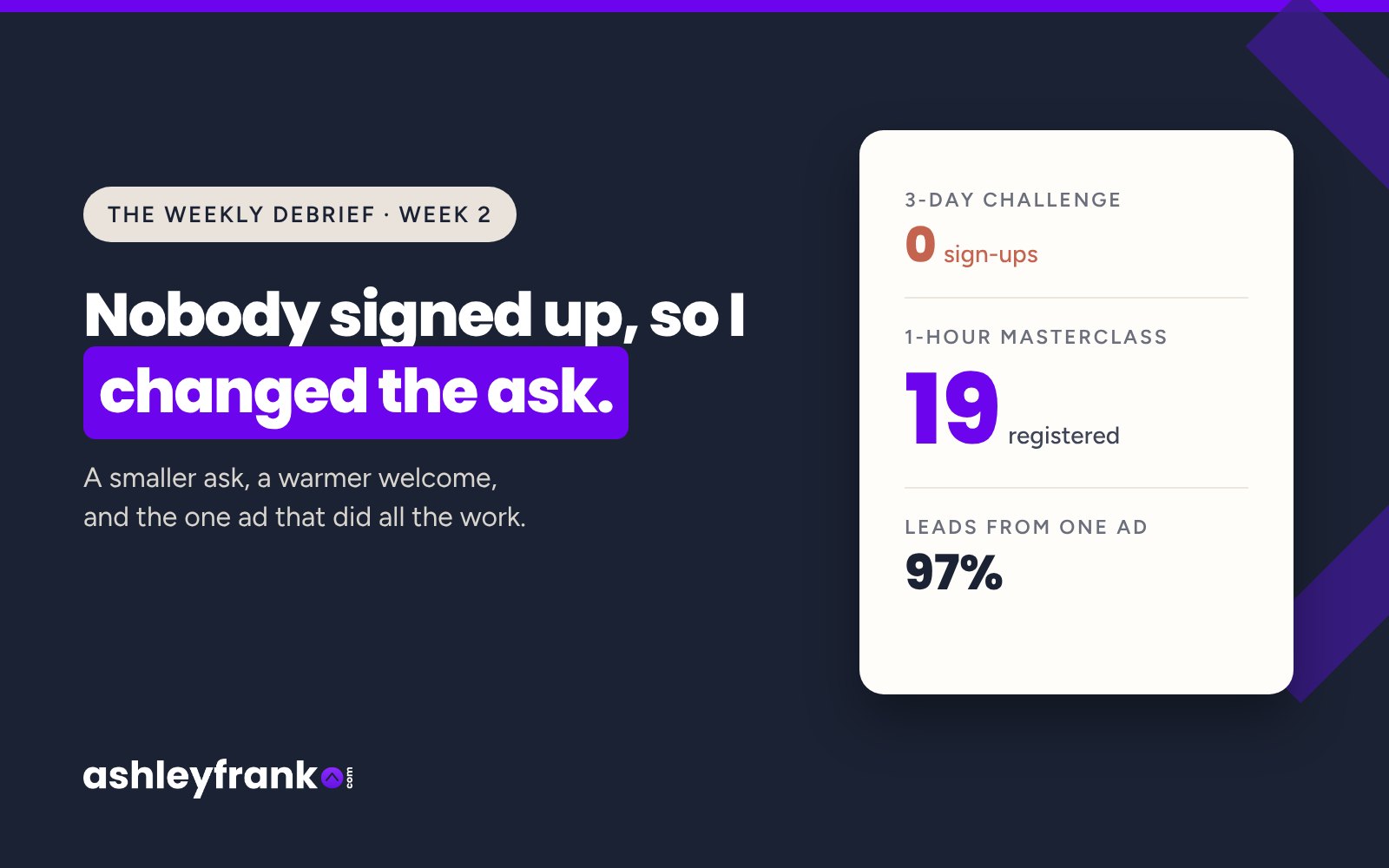
Last week, I ended with a cliffhanger: 126 people had downloaded The Follow-Up Formula, and not one of them had signed up for my free three-day challenge. I said I was thinking about switching to a one-hour masterclass instead.
So here’s week two: what I decided, what I built/rebuilt, and what happened.
This week’s experiment
Week one was about getting strangers onto my email list. ✅
Week two had a different goal: get cold traffic (the people who joined my email list) to take a next step with me. Not just open an email, but actually say yes to something.
Challenge vs. masterclass?
My original plan was simple. Someone finds me through a cold Meta ad, downloads the guide, and over a series of three emails gets to know me well enough to register for a three-day challenge (one hour a day).
I grossly overestimated that approach. After 150+ opt-ins and zero challenge registrations, I realized the ask was too big. Yes, the challenge was free. But people would be investing an hour a day with me, and they had no clue who I was. They came in cold through a PDF download. They didn’t know how I teach, or whether I was worth three hours of their week.
Even worse, I wasn’t really telling them who I was. Outside of a short paragraph at the end of the PDF, I hadn’t introduced myself at all.
So on Tuesday, I made the call: the Confident Closer Challenge is out, and a one-hour masterclass, Fix Your Follow-Up, is in.
One hour is a much smaller commitment for someone who doesn’t know me yet. A masterclass is also much easier for me to run more often than a three-day challenge. My audience is still too small for challenges, so challenges are on the back burner for now. (But not forever.)
One is not proof
Here’s the funny part. While I was in the middle of building the masterclass landing page, someone registered for the challenge.
My first instinct was, “Wait, maybe it IS working.” But I didn’t let it distract me. One registration isn’t proof. It’s one person.
So I kept going, and I emailed that person directly to let them know about the change in plans and invite them to the masterclass instead.
If you run experiments in your own business, this one’s worth remembering:
“Don’t let one data point talk you out of a decision you made from the bigger picture.”
I rebuilt the welcome emails too
The challenge wasn’t the only change this week. I quickly realized that my email sequence was asking too much, too soon from cold traffic.
The old sequence started the day after someone downloaded the guide with an email called “Did you send a follow-up yet?” It asked people to hit reply and tell me. That’s a lot to ask of someone who doesn’t know me yet. And guess what, I got zero replies from that first email.
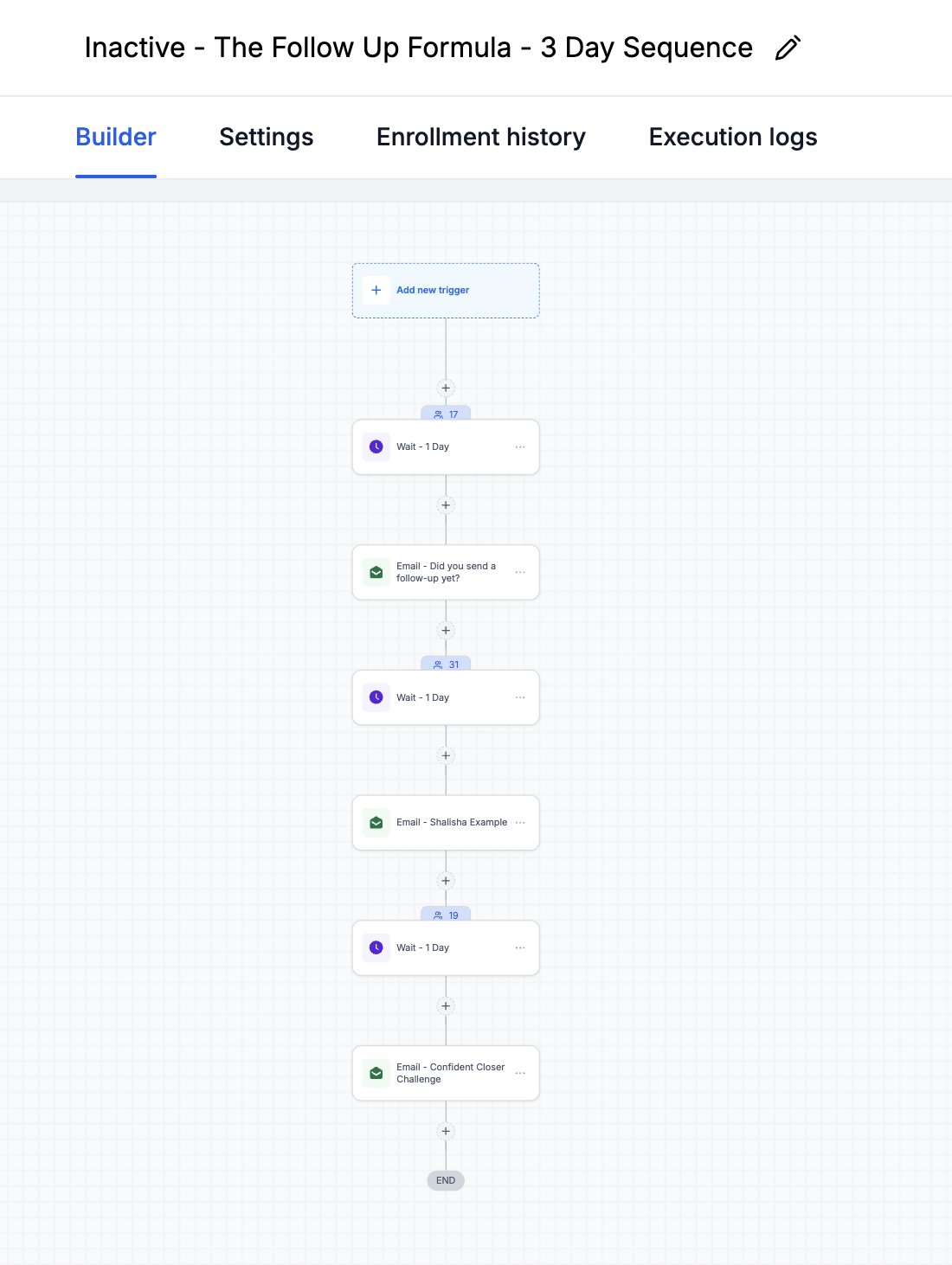
Above: the old three-day sequence, now switched off.
So I rebuilt the welcome emails as a four-email sequence, with the receiver at the centre of each email. The first email doesn’t ask for anything. Its only job is to let people know who I am and give them a reason to listen, with a little belief-shifting and trust-building sprinkled in.
The subject line is the question I imagine people are actually asking: “Who is sending me these emails”. (You’ll notice there’s no question mark. That’s intentional, to help the email land in the inbox. Question marks, exclamation marks, and other symbols in subject lines can trip spam filters and send you straight to the junk folder.)
The email links to a short video where I introduce myself.
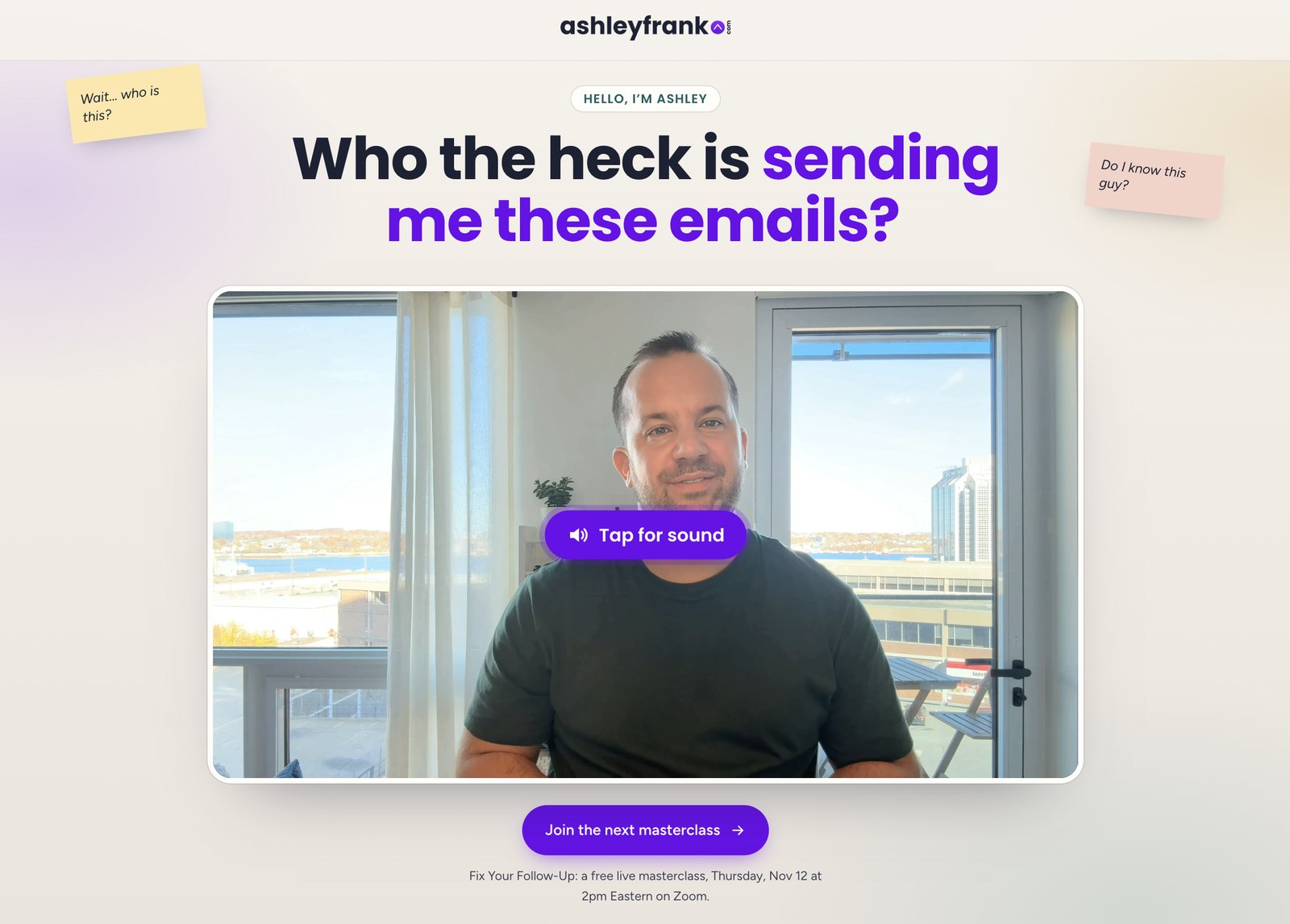
Above: the page behind the first email, where people meet me on video and can join the next masterclass.
The idea is simple. Before I ask anyone for their time, I want them to know who I am and why I might be worth listening to.
What happened (so far)
Two small changes, and some promising results. Keep in mind that my audience is still small (fewer than 400 new names in total), and most people don’t register until the last 24 hours before an event.
19 people have registered for the masterclass so far.
| Registered | Out of | |
|---|---|---|
| Cold (came in through the ads) | 8 | 317 leads (about 2.5%) |
| Warm (my existing email list) | 11 | 69 people (about 16%) |
| Total | 19 |
Two of the eight cold registrations came from a retargeting ad I started on Wednesday. I’m guessing one more came from someone forwarding the second email in my sequence. I don’t know who made the forward, but thank you!
The retargeting ad only shows to people who’ve already shown interest: people who opened the ad’s form but didn’t finish it, and people who visited my website. It’s $10 a day, and so far it’s brought in 2 registrations at $24.24 each.
That’s a lot more than the $1.52 I’m paying per guide download. But compare it with what it costs to get one registration from cold traffic: I’ve spent $482.08 on the guide ads, and six people have registered from them. That’s about $80 per registration 🤯. Suddenly $24.24 looks like a bargain.
My retargeting audience is small, and my hypothesis is that these are warmer leads. They didn’t just tap an instant form inside Facebook. They clicked through to my website and filled in a registration page. They jumped through a few hoops to get there.
Right now, $80 per registration doesn’t scare me, because I’m in experimentation mode. As I adjust my emails and messaging, I expect that number to come down. My target is somewhere between $8 and $20 per masterclass registration.
And even the people who didn’t register aren’t wasted. I’ve added 317 new people to my world who I can build relationships with, invite to future masterclasses and more.
One of my mentors, James Wedmore, often says, “The launch builds the list.” It’s true. This is the heavy-lifting stage.
The ads to the free guide are still doing well:
| Week one | Since launch (Oct 25 to Nov 8) | |
|---|---|---|
| Spent | $203.82 | $482.08 |
| New leads | 126 | 317 |
| Clicks | 240 | 486 |
| Average cost per lead | about $1.62 | about $1.52 |
The budget is still $36 a day, split across the same three audiences. The cost per lead actually went down in week two.
Nerd alert 🤓: one ad did almost all the work
This is the part I find fascinating.
All three cold audiences performed about the same. Entrepreneurs and business owners, coaches, and consultants and advisors all landed between $1.40 and $1.60 a lead.
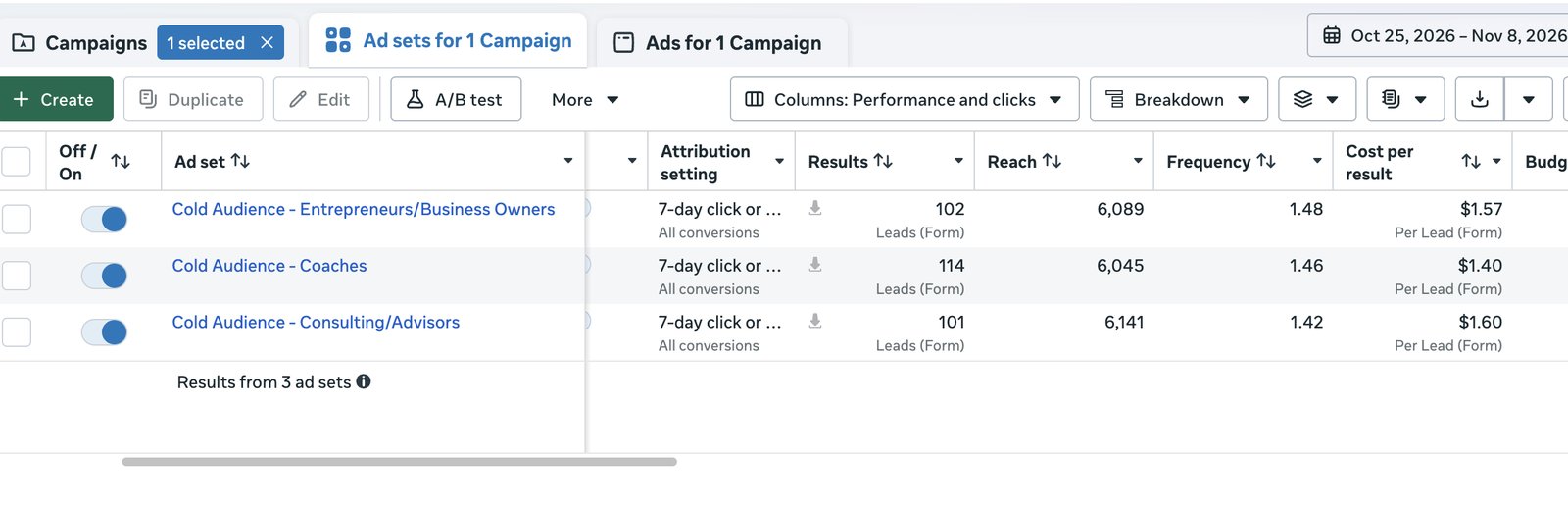
Inside each audience, I was running the same five ads. And one of them won by a landslide. In all three audiences.
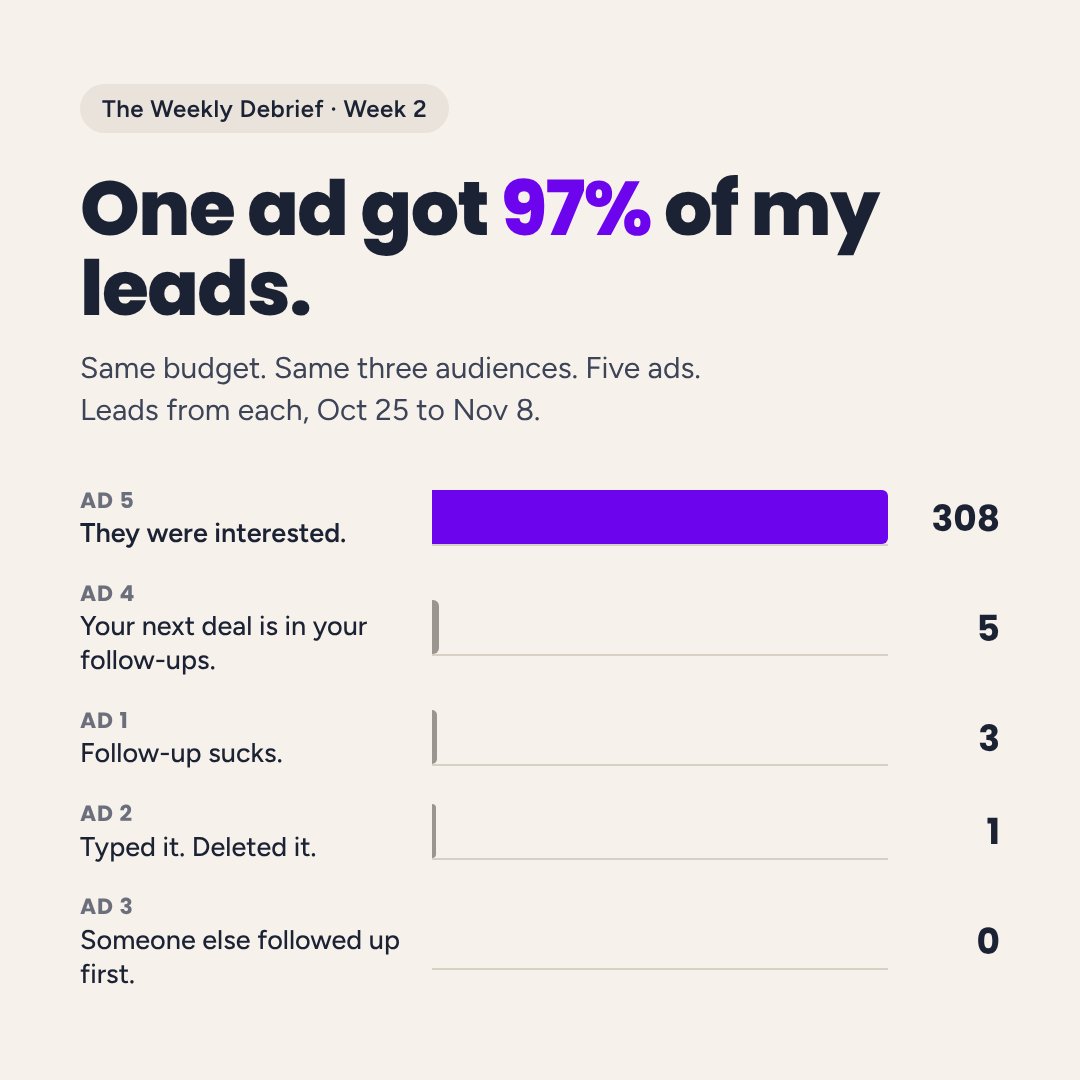
The winning ad spoke to exactly what the person scrolling was thinking: “They were interested. Now they’re ignoring your follow-up.” It outperformed the other ads in every ad set.
Here’s the winning creative. Simple? Yes. Effective? Also yes.
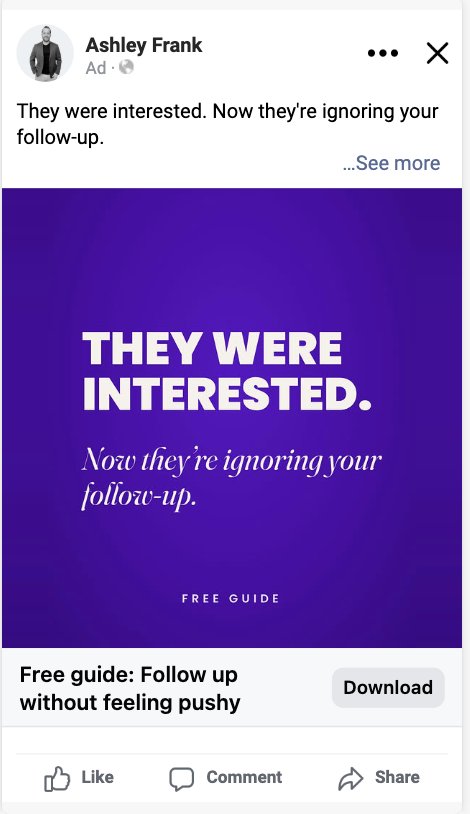
308 of my 317 leads came from this one ad. That’s 97%. That’s not a coincidence, that’s a signal backed by real data.
I’m not surprised. That line is exactly what my ideal client is thinking. They had a great conversation. The person said “send me something.” And now… nothing. The ad doesn’t explain a concept or make a clever point. It just names the moment they’re stuck in.
Compare that with the other four ads:
- “Follow-up sucks. But skipping it is costing you money.”
- “Typed it. Deleted it. Typed it again.”
- “They didn’t say no. Someone else just followed up first.”
- “Your next deal is in your follow-ups.”
They’re not bad ads. Some of them are clever. But they’re one step removed from what the person is actually feeling and thinking.
A quick note for fellow nerds: Meta decides early which ad to show more often, then sends most of the budget its way. So the other four ads were only shown to a few hundred people in total, compared with about 18,000 for the winner. They didn’t get a fair fight. But Meta picked the same winner in three separate audiences, and that tells me something.
The lesson I’m taking away is about messaging, not ads: say the thing they’re already thinking. That works in a Facebook ad, a sales conversation, or the first line of an email.
Honourable mention
One of my cold leads replied to an email directly. A real person, writing back to a stranger who showed up in her inbox from an ad. And she didn’t reply to a sales email. She replied to the email that delivered the free guide, which tells me she’s living in that exact problem right now.
She hasn’t replied since, but she’s registered for the masterclass. I’m counting this as a win.
My warm audience showed up
Here’s something I didn’t expect: the biggest group of registrations came from my own email list.
I’ve ignored my warm audience for much too long. I sent one email to the 69 people on my list. That’s it. Eleven of them registered, including a client and several people from their team, who each signed up on their own.
And at least 10 more replied with some version of “Great to hear from you, but I can’t make it.” So from one email, more than 20 people, nearly a third of my list, either registered or wrote back.
After the masterclass, I’ll be following up with coffee chats.
It’s a good reminder that while you’re out building a new audience, the people who already know you are often your biggest supporters.
What’s next
I’m keeping the ads to the guide running through November.
The masterclass is this Thursday, November 12, and this week has two goals:
- Get 25 to 50% of the people who registered to actually show up. That’s 5 to 10 people. Reminders go out on Wednesday (24 hours before), then on Thursday, one hour and 15 minutes before we start.
- Enroll at least one person in Build Your Sales System program after the call.
- Improve my email click-through rate. Right now, people are opening my emails but not clicking the links inside them. No clicks means fewer masterclass registrations, so this is the next thing to fix.
Come back next week to see how it went.
If you’re running your own experiment
Here’s what week two taught me:
- Match the ask to the relationship. A stranger will trade an email for a PDF. Three hours of their week is a different conversation.
- Introduce yourself before you ask for anything. People want to know who’s in their inbox.
- Keep your messaging simple. The clever message doesn’t always win. The one that says what they’re already thinking usually does.
- Don’t forget your warm audience. The people who already know you may be the quickest yes and your biggest supporters.
- Don’t let one data point derail your plan. One yes isn’t a trend, and neither is one no.
Want to fix your follow-up with me? Join the free masterclass on Thursday. Or grab The Follow-Up Formula, the same guide everyone’s downloading.